Imagine her with me if you would, a young girl sitting in the church pew, absorbing hundreds of hours of preaching and teaching. Extra-biblical mandates, woven between the lines of Scripture, shaped her conscience, leading to a striving for approval and the brittle comfort of control.
Coupled with an aspiration for true holiness were layers of restrictions, sometimes fueled by fears and suspicion. She was told that music containing drums had its roots in demonic African religions, and holidays like Easter and Christmas were condemned because of their pagan origins. Everyday decorations, media, and clothing styles were purported to carry risks of dangerous spiritual repercussions. It was taught that not only sins, but certain things like these, could lead a Christian down a dark path, or even cause the loss of their salvation, and that the devil would ferociously devour them.
The girl became a young woman, and watched as some of her friends carried these core beliefs even further, influenced by troubling ideologies. Some felt compelled to scour their family lineage, convinced that ancestral iniquities could grant demons legal rights in their lives. Or that being in physical proximity to certain things, even unintentionally, would be “signing a contract for the devil to take your mind.” They scrutinized common symbols and cartoons – believing these, too, could become open doors for demonic oppression.
—The Inescapable Math of Doctrine—
The young woman eventually found herself on the mission field, living in a small mountain house with a tin roof, its yard sharing a fence line with the local witch doctor’s compound. Voodoo ceremonies, rituals, and eerie noises often filled the night air. Suddenly, spirits no longer felt distant: here they were called upon to possess and intervene, idolatry was normal, and witchcraft was openly practiced. As the rituals shattered the nights’ peace in loud, chaotic discord, the years of teaching flooded her mind.
She carefully examined her life and followed the theology she was taught to its logical conclusions. Had she confessed every sin, or was there something she could have missed or forgotten? If so, she could have lost her salvation, and then demons could oppress or perhaps even enter her. Many nights, as tears wet her pillow, she put on headphones as loud as she could bear, letting Scripture songs drown out the sounds outside. She hoped that if she couldn’t hear them, she might be safe. She never told anyone about her fears; she was far too embarrassed. She was sincere in her love, service, and faith in God, but her conscience was gripped by trepidation and legalism. When she finally slept, it was fitful.
Over the following years, by God’s providence, the young woman was given the opportunity to learn more in sound, biblical theology. She learned of God’s absolute sovereignty and that her salvation rested in Christ alone and not her own performance or righteousness. Though she still had much to learn, these truths set her free with a glorious peace and freedom she had never known!
“For I am sure that neither death nor life, nor angels nor rulers, nor things present nor things to come, nor powers, nor height nor depth, nor anything else in all creation, will be able to separate us from the love of God in Christ Jesus our Lord.” (Rom. 8:38–39)
The young woman also learned what healthy discernment looks like and that God created many good and beautiful things to be received with gratitude for His glory. Though the world may tremble, the truth of God’s Word stands firm and never changes. This assurance was profound and became an anchor and passion in her life that changed everything. Her spiritual fear was gone.
—An Old Worry in a Modern World—
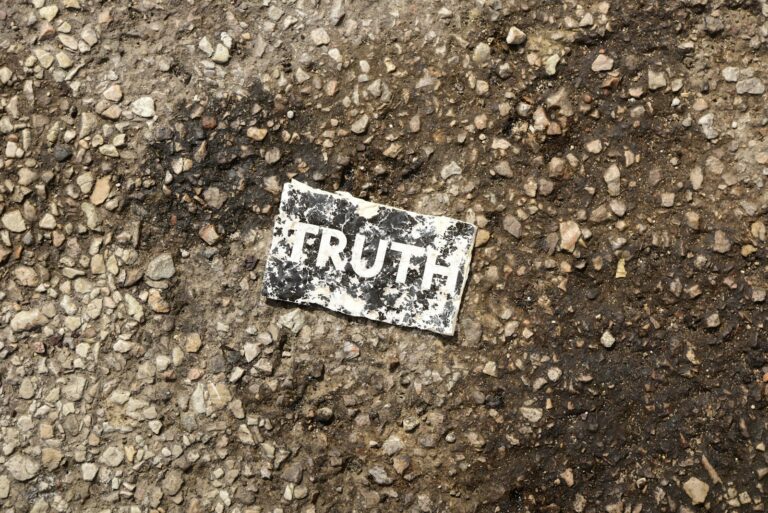
The story of this girl illustrates that doctrine doesn’t remain abstract. It trains us in what to fear and what to trust. For the sake of clarity, when I use the word doctrine, I mean what the Bible directly teaches, not our personal opinions or preferences. Scripture describes God’s truth as sharper than any two-edged sword. It does more than guide; it also divides and discerns what is from God and what is from man (Heb. 4:12).
A challenge in addressing this topic is that it naturally branches into many areas. Many believers hold convictions, valid or otherwise, in areas Scripture does not explicitly address. I initially explored some of these threads but ultimately narrowed the focus to fear-based beliefs.
Concerning those who are fearful of what they do not fully understand, Scripture speaks with particular clarity. In 1 Corinthians 8, Paul addresses the matter of Christians who were afraid of spiritual contamination from food offered to idols. They believed that eating such food might defile them, as though the idol or any associated demonic influences could ultimately hold power over them. Paul explains that these believers, for whom Christ died, have weaker consciences.
There is a great deal of misinformation surrounding these matters, and deep ditches exist on both sides of the narrow path of truth. 1 Corinthians 8, 10, Romans 14, and Colossians 2 address them extensively.
—The Ditch of the Trembling—
In the one ditch are those who live dominated by their worries. Their knowledge was incomplete, and they were in need of truth that gently reforms the conscience. Paul directs the Corinthians’ attention: “For us there is one God, the Father… and one Lord, Jesus Christ” (1 Cor. 8:6). Satan, demons, and powers are real, but they do not operate outside of God’s rule (for further study, consider the story of Job). Christ has already triumphed over them; He has disarmed the rulers and authorities and put them to open shame (Col. 2:15). We are not vulnerable or abandoned – we are His children, redeemed at great cost. We are in Christ and Christ in us! The solution to a faith ruled by fear filled hearts is settled confidence in the sovereignty of God and Christ’s finished work. Such growth does not come through shame, pressure, or exposure, but through the steady work of truth applied with patient discipleship.
—The Ditch of the Proud—
On the other side is the ditch where we find those who understand their freedom in Christ but whose knowledge, apart from love, can “puff them up” with pride. Maturity is not simply a matter of understanding our liberties — it is learning to exercise them in a way that also protects others.
“Take care that this right of yours does not somehow become a stumbling block to the weak” (1 Cor. 8:9).
“By your knowledge, a weak brother or sister may be destroyed” (1 Cor. 8:11).
It is not an accident that the strongest warnings in this passage are reserved for those whose insight has the potential to wound the conscience of the weaker.
For if we do so, we sin not only against them but Christ himself (1 Cor. 8:12).
Between the two extremes lies the path of wisdom and truth. Two things hold true: 1. Christian liberty is a privilege meant to be exercised with love. 2. God commands obedience, vigilance, and discernment. (Col. 2; Rom. 14; 1 Pet. 5:8; 1 Thess. 5:21)
—The Weight of Our Words—
It can certainly be a temptation to dismiss the weaker or wrongfully label them. I know I too am guilty of this at times. However, the Lord calls us to a deeper and gentler way. Sometimes our sincerity can be misguided. Recently, I became aware of a concept that is circulating, claiming that Christians who struggle with these fears are actually “entangled in the true form of witchcraft.”
Beyond being in serious tension with Paul’s teaching, Scripture already defines witchcraft clearly. Biblically and historically, witchcraft means the use of sorcery or magic, or communication with the devil or a familiar (Deut. 18:10–12). As the girl in the story, I try to imagine being told then that I was actually involved in witchcraft. To apply such a morally grave label to a conscience laboring under ignorance could be crushing.
This idea does not stand alone. It flows from a broader framework of strange notions that may sound compelling on the surface, yet fail under careful theological examination. We must be careful with what we take into our hearts, and those who teach carry responsibility for the content they communicate (James 3:1). What we believe affects everything: how we live, how we counsel, and how we build up – or tear down – the body of Christ. We must hold all things to the standard of Scripture, never adding to or subtracting from God’s Word.
—The Cosmetic Holiness of “Do Not Touch”—
Sometimes, weaker believers are wrongly permitted to become bullies, or even false teachers, controlling and dictating what others may or may not do. In Colossians 2, Paul warns against those who “judge you in questions of food and drink, festivals, new moons, or sabbaths.” They impose self-made religion and neglect of the body through regulations, “Do not handle, do not taste, do not touch”. These human commands and teachings have the appearance of wisdom but are of no value in restraining the flesh. For this reason, discernment, governed by Scripture and exercised in love, is essential for knowing when patient forbearance is required or when admonition is necessary for the good of others.
—Our Fellowship in Shared Grace—
There is a great deal of muddy teaching surrounding these issues. In my research, I have grown increasingly concerned by the depth of misunderstanding and the arrogance that sometimes accompanies it. This was extremely convicting for me to write. I don’t think any of us has this down the way we should. At times, the weaker judge the stronger, and the stronger despise the weaker. But we can learn from one another, and I believe dialogue is both good and healthy. Online voices today rapidly spread cooled truths and warmed-up lies. Now more than ever, we must be grounded in the Word, faithful to truth, and marked by deep love for one another, living in Christ and for His glory.